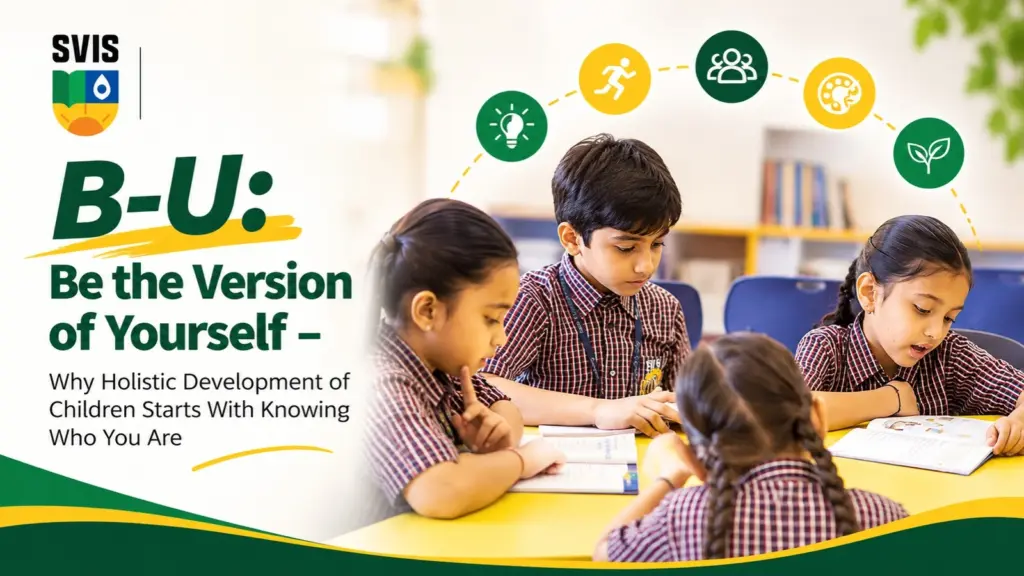
Most schools talk about developing the child comprehensively. Fewer actually build something around it. The B-U campaign at SVIS, which stands for Be the Version of Yourself, starts from a simple premise. Every child carries potential that a purely academic environment will never fully reach. Now, the question is how to create the conditions that would help that potential show up. Parents prioritizing holistic development of children are exploring the faculty and infrastructure at SVIS for a better idea of the campaign.
What B-U Means for the Holistic Development of Children
The idea behind the B-U campaign is that children can develop their latent faculties when they get the space to find out what they are actually good at. It’s part of the child’s personality development work the school has put in place. The school designed B-U around ongoing engagement, with consistent experiences, small challenges, and productive environments.
Why Can’t Holistic Development of Children Happen in a Classroom Alone?
The concept of student confidence can sound simple to most parents. But at some point, you may watch a child who is academically capable, but completely shuts down when it comes to speaking in front of a group. Again, some children face a tough time during exams, but they shine during a debate or a science project.
Many parents have a common question—how to build confidence in children. Children develop confidence when they face situations that let them discover themselves. If a child has never faced a real challenge, they have no evidence that they can handle one. The right activities and the right mix of individual and group challenges can let a child work through something on their own. Modern teaching methods are effective in nurturing the individual skills in children.
Holistic Development of Children and the Question of Talent
At some point, every parent wonders whether their child has a particular talent. You might also be wondering whether the school is active enough to find it out. But the question is, how do you help a child discover their talent? The process shouldn’t run parallel to school, but it should run through it.
Holistic education works well when schools treat the curriculum as one input among many, not the only thing that matters. Sports, creative arts, public speaking, collaborative projects, and community activities—all these activities should be a part of the curriculum. When a child discovers that they are a natural leader during a group project or finds a real love for drawing during an art elective, they are learning about their abilities. No exam can measure this process of self-discovery. Parents can understand the importance of holistic education when they look at what children actually carry into adulthood.
Personality Development Activities for Students
Personality development activities for students that actually make a difference share a few things in common. They involve real stakes, even if small. Each one requires the child to make decisions. Most also put the child in front of other people in some way, whether through performance, presentation, or collaboration.
At SVIS, B-U gives students those experiences across different areas so that no child goes through school without finding at least one thing they feel capable of. For a broader view of how life skills develop through school activities, check out the importance of life skills, which covers the thinking behind it well.
Conclusion
The process of holistic development of children takes time. It is the result of years of deliberately creating the right conditions and then getting out of the way enough for a child to actually grow into them.
B-U at SVIS rests on that belief. Every child has a version of themselves worth becoming. The responsibility of the school is to help them find it.


